Showing posts with label distribution. Show all posts

5.1.11

His Master's Voice

2011 starts with the news that HMV have announced their intention to shut 40 branch locations this year.

The alarm bells are not only the poor Christmas trading - but the rumour that the company was having trouble meeting their bank loans. 

Over the past few years, it's been clear that record retail - in the form of physical sales - has been shrinking; not only the amount of HMV's shelf space devoted to CDs, but the disappearance of chains such as Fopp and Virgin Megastore. In the case of HMV, I'm neither surprised nor disappointed.

From an artist and a label perspective, HMV's approach to retail is in no one's favour but their own. Their margins are massive and yet they demand one of the highest discounts on PPD than any of the other retailers. This is the set rate that a distributor sells CDs at to stores. HMV then request a discount of 20% or more, depending on the relationship they have with the retailer. Independent stores would get this discount, but because of the size of HMV, the discount is granted.

Distributors love HMV because they buy in bulk volume. HMV has over 250 locations - so each album release could get a hefty minimum order. The problem for the label is that distributors make their commission up front - labels pay around 20% for every unit shipped. If HMV don't sell your album in a few weeks, they return them. And the distributor keeps the commission.

It gets worse. HMV orders weekly, with each store putting a separate order in to the distributor. So even though you may have returns from the Glasgow branch, the next week might see orders from Bristol. The same CD returned to your distributor could be resold to HMV, and then even returned again. 

As an artist having your CD in HMV once gave you credibility. But once the discount was applied, you weren't making much in revenue from your sales. Then taking into the account returns - well, you could find yourself losing money on a release.

This distribution-retail relationship has always been one of my biggest issues with the record industry. Digital music has none of these problems - music is shipped and sold on demand. With this in place and available to all, there is no need for physical product or record stores like HMV.

If you're one of those who still insist on buying a physical album, there are great independent stores and Amazon who you can go to. For artists, get your CDs out of HMV now - there's no prestige in seeing your work sink with the ship.

Image from Flickr by Max Sparber

5.4.10

Relics


I had a request this week for some of our music on vinyl.

We pressed only six of the Gaymonkey singles/EPs to vinyl. Each was a labour of love - carefully designed cover sleeve, selecting high quality paper stock and finish. Choosing the tracks to be included that would work best on the format.

Not many remain from the pressing - most that weren't sold initally were lost when our distributor went bankrupt. As I found the requested copies from our archive, it felt great to hold them again - memories of achievement.

It also reinforced the reasons why I have become opposed to the physical format. These relics reminded me of the past, but not so much the music contained on them.

Primarily, they are unsustainable, taking up resources and energy to produce that exceed their value. The investment in vinyl and CDs for an artist/label is massive, and a huge barrier to getting your art to the world. Digital formats have revolutionised this.

Physical formats also take control away from the artist. They dictate the use of distributors who retain stock and mark up the retail cost for the consumer. With this in mind, the format actually becomes a barrier between the creator of art and the listener.

And in the digital age, where our music collections are accessed instantly, these relics simply collect dust. Vinyl may look impressive, but CDs lack any aesthetic charm. Vinyl may be recycled and collected, but unwanted CDs tend to end up in landfill. It is sickening to think of the millions of unwanted records that have become waste.

The industry must take responsibility for this - while vinyl has found a niche, the time has come to move away from the CD format altogether. Not only for sustainability reasons, but as part of a journey to align how we see music in our lives - from commodities and things we consume to art made to enhance our lives.

If you don't want to spend the time reselling your old CDs, its good to know that they can be recycled - this is a good resource for facilities in the UK.

Image on Flickr by swanksalot

16.2.10

Streaming: Limitless Choice or Ultimate Connection?


The great streaming debate is not an argument over how long these types of music services will continue to exist. The discussion that is worthy of your 140 characters is around what functionality of the streaming genre will win over in the end? What does the listener want - limitless choice, or connection to the artist?

The front runners in streaming operate primarily as giant jukeboxes and customised radio stations. But some have greater potential to connect communities. So how do they measure up from the artist's perspective?

Spotify (5 million users) has come out as the media's favourite to hype. With major label catalogue from launch (and 6 million tracks in total), most of what the masses want to hear can be found on the service - unless you are on a small indie whose catalogue is part of the millions of tracks waiting to be uploaded (frustratingly our own work is still mostly absent). Perhaps this is being rectified before Spotify launches in the US this year.

Spotify remains, however, a one-way tool primarily for labels and distributors. Certainly artists get exposure by having their entire catalogue on the service. But there is no interaction between artist and music fan. Crucially, Spotify has no reporting tool - so the artist never knows who has been listening to their work.

Essentially Spotify is a bespoke radio channel - offering the seemingly limitless choice we have become accustomed to in the digital age.

Last.fm - who have been on the scene longer and boast 30 million users - offer a more personalised service - giving you the ability to not only play your favourite tracks, but also to scan your iTunes and deliver your own music collection when on the go or when working away from your computer.

Last.fm has also better captured the social aspect of listening by including networking capacity, and the "scrobbler" - which satisfies the desire to show off one's listening habits by measuring and displaying plays in your collection.

For the artist, Last.fm offers significantly more potential to reach your community. Artists have control to upload material instantly, give away tracks, advertise gigs, connect with listeners. There is no need to get a digital distributor involved - which allows small artists and labels to come and play. There are also statistics, including demographics so that artists can build a profile of who their audience is. And the service even measures who is listening when listeners aren't streaming - as the scrobbler captures iPod and iTunes offline data. This gives artists and labels hugely valuable insight into their audience.

Soundcloud is a dark horse that might become the niche label's bestfriend (with 100,000 users as at August 2009). More PR tool than streaming service, the site is a sublime Flash experience with embeddable players and instant track distribution. Every DJ, music blogger and maven should be on SoundCloud, connecting directly and getting fresh tracks from the artists they want to hear from - rather than relying on pluggers and PR companies.

SoundCloud's potential is still being realised - but the new mobile app is quite exciting. The opportunity to have a mini FTP on your iPhone with this functionality is revolutionary.

Of course there are other services operating but the three here capture the features that are currently available to the audience and artist. Spotify may be taking all the limelight right now, but is it over offering on catalogue and under performing on the extras that actually help artists to reach their listeners? Perhaps if these services hone what they are really good at we will actually have a handful of great resources to use.

Image from Flickr by Mark Heard

8.7.09

Sony Gets Some Tail


I was invited to attend the launch of Chris Anderson's new book - Free - last week. Alas at the last minute I found that the one thing that was lacking in my life, was free time. Anyways, I'm quite certain that he wasn't about to be giving his latest manifesto away gratis. After the grilling he was given by his peers perhaps this latest endeavour won't be as favourable received as The Long Tail.

One other thing nearly slipped my attention this week. As I was cleaning out my inbox I caught sight of a slice of Music Week spam with news that Sony had bought a slice of IODA - who just so happen to be the digital distributor of choice for Gaymonkey.

Could this be? A frantic Google search led me to an article at Wired (the fabulous periodical edited by noneother than Mr Long Tail himself) confirming that indeed the major label is now involved with a digital distribution arm set up as an alliance of independent labels - with the belief of the long tail at the forefront of their business strategy.

A threat to our indie integrity - or a giant 'told you so' ... perhaps both. Still its an interesting sign of the times considering the last decade has been primarily about the majors protecting their assets and shunning anything that wouldn't draw what they considered to be a commercial audience. Provided IODA don't forgo their own intentions, perhaps we should all just be flattered that the big boys want to come play on our patch for a change.

14.2.09

Less Industry, More Music


"The music industry is really focused on the ‘industry’ part and not so much on the ‘music’ part. This is the greatest moment in the history of music if your dream is to distribute as much music as possible to as many people as possible, or if your goal is to make it as easy as possible to become heard as a musician. 

There’s never been a time like this before. So if your focus is on music, it’s great. If your focus is on the industry part and the limos, the advances, the lawyers, polycarbonate and vinyl, it’s horrible."  -- Seth Godin

Seth often chooses to look at the music industry as an example of how the world we live in is changing - and how the challenges presented are actually vast opportunities. I couldn't agree with him more. At Gaymonkey, we have always been about making brilliant electronic pop music.  Of course we like to make some money - but only so that we can make more music. 

And we like to share that opportunity with new people we love - like Ebb or MaJiKer. Or the boys from the Feed collective.

One of the greatest lessons I have learned on this journey was summed up on day in Amato's board room, when our account manager asked why we couldn't just get a "really good remixer to fuck up a track so that you can sell some records". A year later they went out of business. We're still making music.

Image by bdesign.be

5.1.09

We're Shopping


Back from a great xmas trip to the US - with some mild jet lag that sees me up at 5am. But more on that later ...

On my marathon journey home I noticed an article in The Times on music sales revenue, which is reportedly down 32% from five years ago. This is mainly attributed to deflation, as bigger retailers (like supermarkets) discount their product. According to the report, the volume of music has actually increased - although album sales are down 5.6%, single sales are up 36% due to the availability of solitary track downloads.

So despite the industry's insistence that piracy is killing music sales, it is clear that people are still buying - they are just being more selective with their choices, possibly by shopping down the long tail.

This comes with the news that hideous UK retailer Zavvi (or what-ever-happened-to-Virgin?) has gone into administration. We'll have to see if they find a buyer and bounce back - but it doesn't bode well for high street music retail. We're left with HMV and a handful of Fopp locations ... 

The question remains - why shop in these stores? With the internet making infinite choice available - in best case scenario, direct from the artist or label, thus bypassing the tedious middle man - why bother with high street stores at all? Bargain bins, limited choice, having to sift through Akon albums - surely we have evolved passed all this?

Image by roughdrft on Flickr.

12.8.08

Long Tail Epiphany Pt 1: The Death of Distribution


I've been delving deeper into the concept of the Long Tail - which is proving to offer me multiple epiphany moments.  Anyone working in the music industry that hasn't read it should - in fact, I have a feeling most major label suits have read it - and it scares them shitless.

One of the laws of the Tail is to "Democratize Distribution". In the digital world of infinite choice, the old rule of the industry does not apply - physical distribution is no longer the key to reaching your audience.

When Gaymonkey launched we worked hard to find a distributor. We were rejected by many of them because we didn't have the sound they were looking for (which puzzled me greatly - what did a distributor know about what music people wanted to listen to - surely there is an audience for everything?). But when Silence started to get a lot of attention, the distributors came to us.

We thought we had it made - the door was unlocked - finally people could get our music. And at the same time we had made some strong decisions around our digital presence. Things were great.

But soon I realised it wasn't going to be so rosy. Distributors don't just sell your music - they control it to maximise their profit potential. To sell more units, they strive to push your catalogue into "the curve" - the mass market space everyone has traditionally battled to be in. Selling a few units a week to stores is too time consuming to them - they need you to have a hit, or you aren't worth their time. 

So in true freakenomics fashion, they force albums into big retailers hands (HMV, Virgin, Fopp, Play.com) - the distributor makes money on initial units shipped - even if it is returned, they still keep their cut, while the labels are forced to foot the bill. The label loses out, and so does the artist.

It was suggested by our distributor that we were "too niche". They worked hard to get all their albums into the curve, and we needed to be there too. Last year they went bankrupt.  So did Fopp. Virgin has gotten out of its music retail division, and HMV has significantly trimmed down its inventory to focus on games and compilation CDs that they can flog at high volume over xmas. Maybe the curve isn't so great after all. 

In our new world of democratized distribution, the label and artist controls the release schedule. We still work closely with our digital distributor to plan our releases, but there is no pressure to modify our catalogue or promote within the curve. Because in the Long Tail niche is respected - and in the end the listener has the infinite choice.

Image by noseacuerdan on Flickr

19.4.08

Control


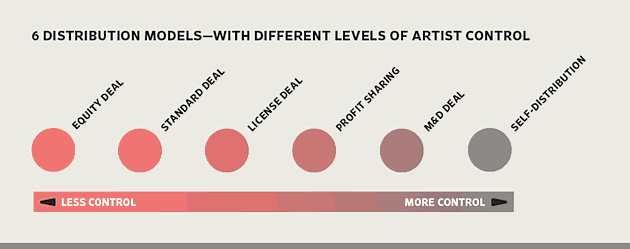
Distribution is, in my opinion, a dirty word.  When you start out in the music industry, all you care about is your distribution deal.  You believe that without it, no one will take you seriously - and you will never sell any records.

Last autumn, our CD distributor Amato went bankrupt.  Months of hard work on promoting the new Sara Berg album went down the drain.  Our stock is still sitting in their warehouse, held up in legal wranglings.  Why did this happen? Amato was one of the largest independent distributors in Europe. Well, some dinosaurs with outdated methods of selling music ran up debts and the company sank.  Many of Amato's labels will never see their past six months sales, and will never recover the debt that the distributor left them.

The doom and gloom that hangs over the music industry is beginning to tire everyone - not just those of us that are confronted with it daily.  All the boys in suits that run the show are scared - their old business model isn't working anymore.  They want to keep people buying CDs because the supply chain - from manufacturing, to distribution, to retail - is also controlled by them.  This is one of the reasons why they hate downloads so much.

Control is something that is traditionally taken away from artists. Once you sign a deal, your art and everything else that supports it belongs to the corporation that controls you.  The ethos behind Gaymonkey has always been to give the artist complete freedom to create what they want, with the belief that there will be an audience for brilliant electronic pop music.

Even distributors feel like they should have some of this control - they decide how and when your music will get in stores, and even like to share their opinions on the music with you.  If they don't personally like it, they will make less of an effort to sell it to the stores.  

With no physical distributor, labels are forced to think differently. Which is a great thing for music.

David Byrne thinks so too - check out his brilliant article from Wired magazine here.